
Equilibrium:
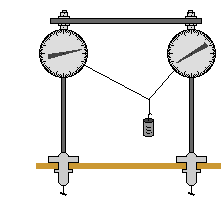
Shows an iron ring on which two equal forces are acting in opposite directions. Obviously the ring will remain at rest. This shows that both the forces F 1 and F 2 cancel the effect of each other and the ring remains at rest. This is only possible if forces F 1 and F 2 are equal and opposite and acting along the same line. In this case the resultant of these forces is Zero.
In case the two forces acting on the ring were not equal, the ring would move in the direction of the greater force. In the first case we say that the ring is in equilibrium while in the second one it is not in equilibrium. Every body will be in equilibrium if the forces acting on it must cancel the effect of each other. In order words, there is no unbalanced force acting on the body when it is in equilibrium. This was an example of static equilibrium.
For further elaboration of bodies in equilibrium, let us consider a car moving on a road with uniform velocity. Hence also two forces are acting on the car in horizontal direction. The force of engine is acting in the forward direction while the force of friction between road and types is acting backward. These two forces, being equal and opposite cancel the effect of each other and the car moves with uniform velocity. If these forces were not equal, the velocity of the car would not remain uniform. Here the car is an example of dynamic equilibrium. From the above examples it is clear that if a body maintains its state of rest or of uniform motion and does not rotate about its axis of rotation under the influence of these forces then it is said to be in equilibrium. In such a state, the resultant of all the forces acting on the body must be equal to zero and the torque acting on the body must also be zero. The concept of torque will dealt in the next section.
Examples of Bodies In Equilibrium:
Consider a book of weight 5 n lying on a table. There are two forces acting on the book. One is the force gravity acting downward and other is the reaction of the table acting upward. As the book is at rest, therefore both the forces cancel the effect of the each other and the book is in equilibrium. This is an example of static equilibrium.
For further elaboration of bodies in equilibrium, let us consider a car moving on a road with uniform velocity. Hence also two forces are acting on the car in horizontal direction. The force of engine is acting in the forward direction while the force of friction between road and types is acting backward. These two forces, being equal and opposite cancel the effect of each other and the car moves with uniform velocity. If these forces were not equal, the velocity of the car would not remain uniform. Here the car is an example of dynamic equilibrium. From the above examples it is clear that if a body maintains its state of rest or of uniform motion and does not rotate about its axis of rotation under the influence of these forces then it is said to be in equilibrium. In such a state, the resultant of all the forces acting on the body must be equal to zero and the torque acting on the body must also be zero. The concept of torque will dealt in the next section.
Examples of Bodies In Equilibrium:
Consider a book of weight 5 n lying on a table. There are two forces acting on the book. One is the force gravity acting downward and other is the reaction of the table acting upward. As the book is at rest, therefore both the forces cancel the effect of the each other and the book is in equilibrium. This is an example of static equilibrium.
- Two forces act upon the book, the force of gravity downward and equal force by the table upward.
- After a parachute opens and falls a certain distance, it moves downward thereafter with uniform velocity.


